


A Cross-cultural Comparison of Confectionery
Sweets are a source of comfort for many people. Eating them once or twice a day is just not enough. It’s a dangerous temptation, but as a sweets lover, I am obligated to try out cafes and confectionery stores. Especially when it comes to ‘Wagashi’ (Japanese confectionery). There hasn’t been a moment I haven’t thanked God for bringing me to Japan, for the wonderful flavors that bless my taste buds and the ability to see these beautiful pieces of art.
Having been born in America, raised in India, and presently being in Japan for a year and six months, I have been fortunate to experience the sweets that prevail in different cultures. I noticed distinctive differences in the confectionery of each culture. I hereby brag on my perspective of the sweets I have encountered in America, India and in Japan. In a nutshell, Japanese sweets are a blessing for my sweet preferences as they feel much lighter even after consuming many servings compared to the heavy and rich western and Indian sweet varieties. Furthermore, I would like to introduce the more well-known confectionery stores that I visited in the city of Ofunato, Japan!
Asian sweets are unique and rarely do I see any cultures trying to imitate these sweets. On the other hand, unlike Asian sweets I have seen wide variations of western-style confectionery available all over the world, and I have yet to try them all. Each nation comes up with their own variations of western sweets. For example, the carrot cake I get in America is not so carrot-y and the heavy cream cheese makes up most of the flavor. However, carrot cakes in India are a much healthier and tastier version with high carrot content. Plum cakes are a Christmas special in India and are rich in fruits and nuts.
Japanese adaptations of the western sweets are a total contrast to the sugary and rich western counterparts. I have noticed that western sweets made in Japan are light and less filling but are alarmingly delicious! One of the pâtisserie in Ofunato city I frequently visit, ‘Lorraine’, amazes me with their light, blindingly mouthwatering presentation and taste.
Personally, I think western sweets are comparatively heavier and are stronger and richer in flavor. Most of them are baked goods rich in dairy products with a surplus of sugar, but they are sinfully delicious. Of course there are organic ones too – low in sugar, but what are sweets without dairy and sugar?
I especially love how in western sweets there is a balance of flavors and textures with the incorporation of a blend of fruits, nuts, chocolate, vanilla, caramel and many more that I cannot think of at this moment. My personal favorite among them is chocolate. The only problem with western sweets for me is that it’s the very image of guilty temptation, heavy with its rich contents and irresistible beyond imagination. I consider them an occasional treat.
With the changing seasons in America, I remember relishing the seasonal and holiday specialties such as:
Pumpkin and pecan pies for Thanksgiving in autumn.

Peppermint bark, gingerbread cookies during the Christmas. season

Fruit pies & cobblers during summer. Especially apple pie, peach cobbler, blueberry and cherry pies on the fourth of July (American Independence Day).

Apple cider donuts, cinnamon donuts, and apple pie desserts in fall!
Paczki, a polish jelly-filled donut enjoyed on Fat Tuesday.
Chocolates & Red Velvet, popular for Valentine's Day.

In addition to the season, there are regional desserts like sweet potato pie in the south, and key lime pie in Florida.
My favorite ritual is making s’mores (toasted marshmallows with milk chocolate sandwiched between graham crackers) and drinking peppermint hot chocolate topped with marshmallows before the fireplace. It is a campfire treat that is best to enjoy on summer nights. We also have National S'mores Day on August 10th. Last but not least, you know it’s Christmas when they start selling peppermint hot chocolate at Starbucks, but what is hot chocolate without marshmallows?

Indian sweets are a total contrast to western sweets. The main contrast is that while western sweets are mostly baked, Indian sweets are mainly made on stove tops. While western sweets use milk products, Indian sweets use milk itself in many forms flavored with popular Indian spices. When western sweets use butter and sugar for baking, Indian sweets use ghee (clarified butter) and sugar syrup. Indian sweets are unique in preparation and presentation and for anyone who is new to Indian sweets, the contents maybe hard to describe. You witness art in its presentation. Indian are usually made of milk, gram/chickpea flour, semolina, rice flour, and coconut sweetened with white sugar or jaggery in the less commercial ones and are flavored with cardamom, saffron and rose water. There are many varieties of these oily, dairy-rich sweets made during different religious festivals, and celebratory events. To list a few popular ones:
Gulab Jamun: Deep fried balls of milk powder dough, soaked in sugar syrup, scented with rose water and flavored with cardamom.
Jalebi: Crispy, juicy, deep-fried spirals made from a fermented and colored yellow or red batter of all-purpose flour, gram flour, ghee, and baking soda and soaked in sugar syrup flavored with saffron.

Kheer: Creamy pudding made from rice, milk, and sugar, flavored with cardamom and saffron, and topped with almonds and pistachios.
Halwa: Flour toasted in ghee and mixed with sugar syrup to create a chewy, translucent, glossy texture, flavored with nuts, spices etc. It comes in many varieties.
Ladoo: Refers to its ball shape and is made from deep fried chickpea flour batter dropped in small drops into hot oil which is then soaked in sugar syrup and shaped into small balls.

Rasmalai: Cottage cheese dumplings made by boiling whole milk and treated with lemon juice which is then soaked in sweetened milk flavored with cardamom and topped with almonds.
Barfi/ Peda: Milk fudge made from condensed milk and sugar in ghee and topped with pistachios/almonds. Barfi has an edible silver leaf base.

Soan Papadi, mysore pak, payasam, etc. are also popular. I could rant on and on about the different textures, colors and shapes even more but let’s save it for another time. For birthdays we enjoy payasam, a milk or coconut milk and jaggery-based lentil/ wheat/vermicelli pudding which has different varieties. Enjoying payasam is a birthday ritual all over India in addition to the cutting of the birthday cake. My favorite is semiya-payasam which is vermicelli noodles simmered in milk with cardamom, cashews and raisins. Many people enjoy it hot, but I like it refrigerated. Christians in south India make ‘Kozhikatta’ on Kozhikatta Saturday which is a lenten observation, an idea similar to the making of Paczki made in the west in relation to Fat Tuesday. Kozhikatta is steamed rice dumpling with coconut, and jaggery fillings and is a bit similar to the Japanese confection, ‘dango’ of Japan.

Now that I have shared basic concepts about how I understood western and Indian confectionery, I would like to explain my thoughts on wagashi. First of all, I think of them to be the total opposite to western sweets, but the presentation is a bit similar to Indian sweets. Wagashi is a piece of art representing nature itself. It is simple and elegant. The colors, not too flashy like Indian sweets and easy on the eyes.

Living in Japan I have come to realize how wagashi is closely tied to the history, climate, and culture of nearly every town and city in Japan. Local ingredients are used to create a wagashi unique to that town and city. The main ingredients being plant-based with minimal sugar and no dairy. Mochi (glutinous rice paste), anko (red beans), kinako (powdered roasted soybeans), matcha, chestnuts, sweet potatoes, and various fruits are some of the common, well-known ones.

The same sweets sold in two different cities might taste different due to the difference in climate, soil or techniques. In addition to using local ingredients, the wagashi sold changes depending on the season.
Botamochi is a sweet served during spring when peonies are in bloom, and ohagi is a similar sweet served when hagis’ (bush clovers) are in bloom during the fall. The main difference is that botamochi uses koshi-an (smooth anko without skin) and ohagi uses tsubu-an (grainy anko with skin).
One of my favorite things about going to wagashi stores is the display and presentation of the wagashi. Forget if it tastes good! Buy the sweets for their pretty boxes, pretty packaging and beautiful display. Why look outside at nature when you can see nature inside a wagashi. If you buy wagashi, even better! You taste the nature!
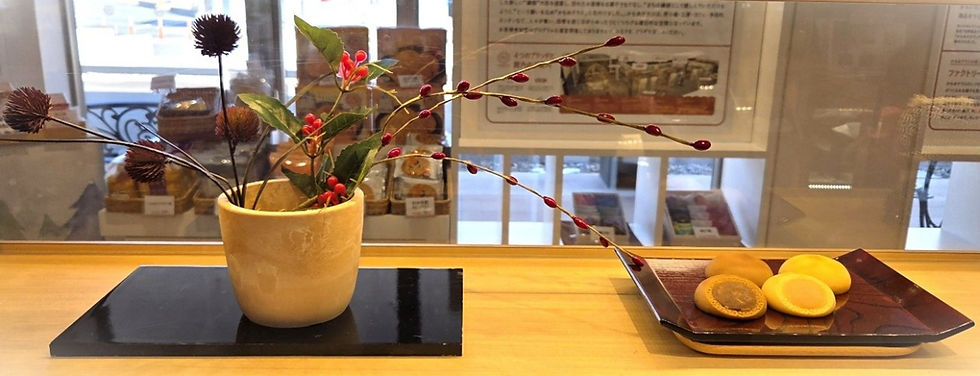
Speaking about Wagashi shops, I would like to introduce some of the popular wagashi stores of Ofunato City in Iwate Prefecture!
Kasho Takase

This cute shop located in the Kyassen Shopping district is famous for their ohitotsu and ama-hotate (sweet scallop). Ohitsotsu is a manjuu with a soft covering of brown sugar filled with anko inside. Perfect to eat with tea and coffee. Ohitotsu means one, as in one bite or in one breath. You savor that one bite... but then it’s gone and you still have a lot of tea or coffee left. So, you take another bite, and another, and another, and another. You keep on taking A BITE until you’re out of tea.

Ama-hotate (Top left) & O-hitotsu (Bottom right)
The wagashi, ama-hotate has an outer shell made of monaka (crisp wafer) and is designed to look like a scallop. The inside is filled with smooth anko and soft, sticky mochi!
I also recommend their uguisu, and sakura mochi made in preparation for the Hina festival in February. The sakura mochi especially looks like a gem and the uguisus’ green kinako powder reminds me of the upcoming spring season.

Sakura mochi & Uguisu mochi

Ohuraya

A cute confectionery shop known for their sake cake. Yup. It’s cake and sake! A blend of the east in the west. A western cake (likely castella) that seems to be soaked in Japanese wine. The moment you open up the ivory wrapping around the cake, a waft of Japanese sake forces itself into your nostrils and that is a moment you’ll never forget. The cake is soft, but it doesn’t break off easily. It’s a moist or maybe juicy mouthful! They are also known for their western confectioneries and their almond rock candy. It’s crisp, crunchy and delicious!

Sake Cake
Tsuboya Takou is an appealing store alongside the road with a pleasant atmosphere.

You are welcomed by tons of wagashi such as yubeshi and agemanjuu, along with Ofunato’s famous ‘Hana Tsubaki Cookies’! The cookies are named after the renowned flower of Ofunato, the tsubaki (Camellia). It has two flavors, chocolate and almond. My favorite being chocolate! I especially recommend trying the black sesame and walnut yubeshi. The smooth chewy texture of the glutinous rice flour paired with walnuts or black sesame is a must try! The agemanjuu is a deep-fried bean paste filled bun that is crispy on the outside and soft on the inside. The outer cover tastes very similar to the Indian snack ‘Unniappam’.

Age-manjuu
Last but not least, Kamome Terrace is a beautiful aesthetic shop where they sell the renowned specialty of Ofunato, the ‘Kamome no Tamago’ (Seagull’s egg) made by the company ‘Saitou Seika’.

Kamome no Tamago
Besides kamome no tamago they also sell varieties of baked bread, and western confectioneries. However, the main star is the ‘wayougashi’ (Western/eastern confectionery), ‘Kamome no Tamago’. This simple yet beautiful ‘wayougashi’ is shaped like an egg with the outer covering made of castella dough and white chocolate. The inside is filled with yellow bean paste. Depending on the season, they release different flavors of the kamome no tamago. To name a few, there is orange, blueberry, black tea, apple, chestnut, tiramisu, sweet potato, golden kamome and chocolate. My favorites so far are apple, chestnut and orange flavors. Additionally, during the winter, they also sell strawberry daifuku. With a big’ol strawberry on the inside.

Korogaki – a wagashi made of persimmons and crafted into one.
Among their regular items is grilled mitarashi dango! This gem seriously just melts on your tongue and is especially rewarding to eat during the cold season.

Grilled Mitarashi Dango
I ate two skewers with four on each in one go. It was heaven! Piping hot grilled mitarashi is the best! There is also a beautiful space in the shop to sit and enjoy the snacks you bought, and you can take your time enjoying the free tea while looking out the windows.
I know that by now your stomach must be craving sweets. As fellow sweets tooths, I welcome you to come to Ofunato from wherever you are on the globe and charge into my favorite stores and enjoy the mouth watering experience of wagashi while sipping a cup of tea! I look forward to discovering and trying out more sweets and will be on the lookout for more varieties!
Also, check out the many stores I visited in Ofunato on our instagram account @https://www.instagram.com/experience.ofunato/


コメント